
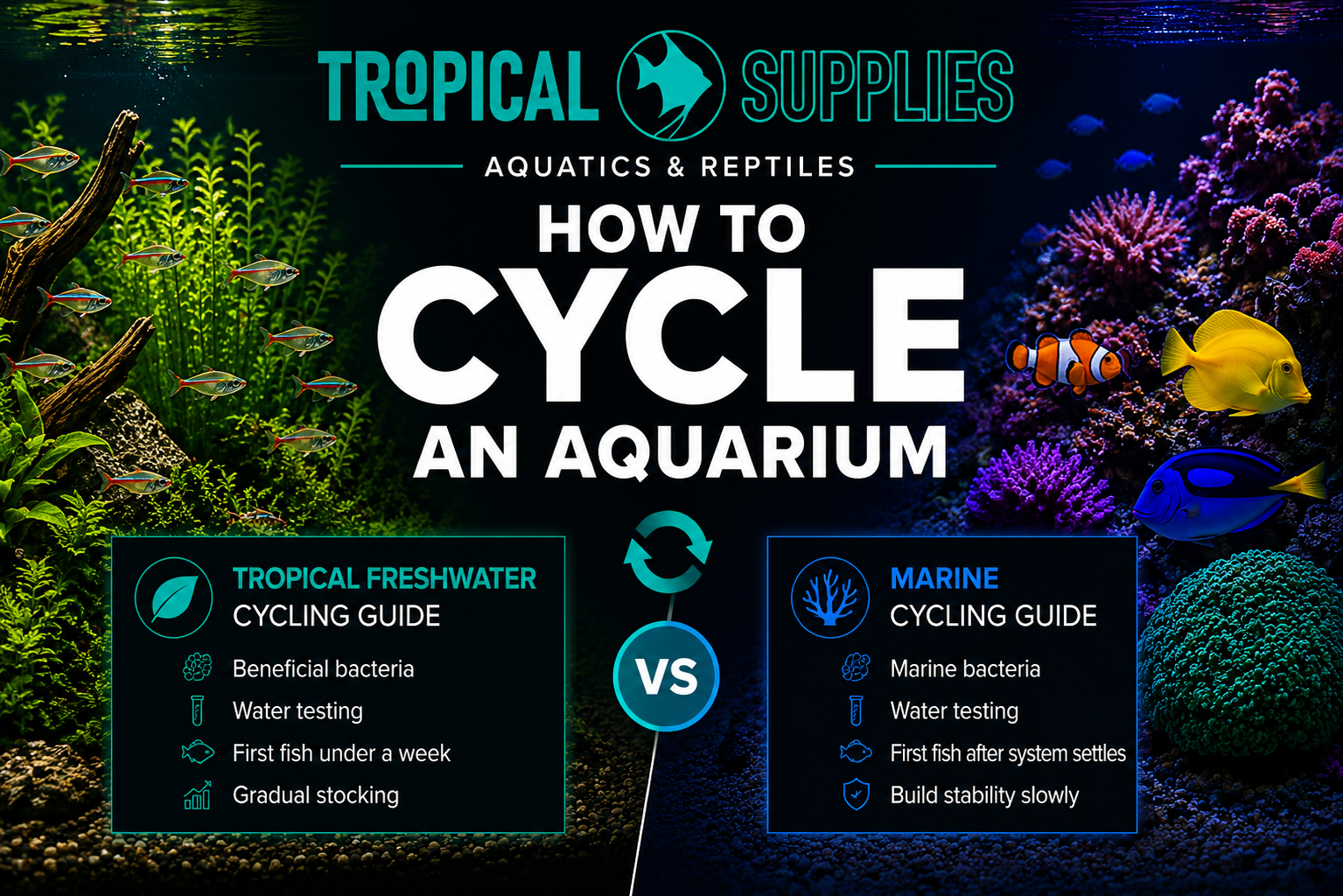
How to Cycle an Aquarium
Cycling an aquarium is one of the most important stages of setting up a new tank.
Before an aquarium can safely support its livestock, it needs to develop enough beneficial bacteria to process the waste those animals produce. This is known as establishing the nitrogen cycle.
The basic biological process is similar in freshwater and marine aquariums:
Ammonia → Nitrite → Nitrate
However, we don't recommend approaching a new tropical freshwater aquarium and a new marine aquarium in exactly the same way.
In this guide, we'll explain the basics first and then take you through the two methods separately.
What Is the Nitrogen Cycle?
Fish produce waste. Uneaten food and other organic material also break down inside the aquarium.
This produces ammonia, which is toxic to aquatic animals.
Beneficial nitrifying bacteria establish throughout the aquarium, particularly within biological filter media and other surfaces. These bacteria process ammonia into nitrite.
Nitrite is also toxic, but another group of bacteria converts it into nitrate.
So, in simple terms:
AMMONIA → NITRITE → NITRATE
Nitrate is considerably less toxic at normal aquarium concentrations and can be managed through regular aquarium maintenance, particularly partial water changes. In freshwater aquariums, growing plants can also utilise nitrogen compounds.
The goal of cycling is to establish enough biological filtration to process the waste being produced by your livestock.
Where Do Beneficial Bacteria Live?
A common beginner misconception is that most of the beneficial bacteria live in the aquarium water.
They don't.
The majority establish on surfaces, including:
- Biological filter media
- Substrate
- Rocks
- Wood
- Aquarium decoration
- Pipework
- Other submerged surfaces
Your filter is therefore much more than something that catches visible dirt. It provides an important home for the bacteria responsible for biological filtration.
Before We Go Further: Freshwater and Marine Are Different
This is where we're going to separate the two approaches.
If you're setting up a tropical freshwater aquarium, continue with Part One.
If you're setting up a marine aquarium, jump to Part Two.
PART ONE: CYCLING A TROPICAL FRESHWATER AQUARIUM
For most new tropical freshwater aquariums, we don't believe you necessarily need to leave an empty aquarium running for weeks before introducing any fish.
With the aquarium set up correctly, a suitable bacterial starter added and careful monitoring, a small number of suitable fish can potentially be introduced within the first week.
The important words there are small number.
Adding a few fish to begin establishing the system is completely different from fully stocking a brand-new aquarium.
Step 1: Completely Set Up the Aquarium
Before introducing any fish, get the aquarium itself running properly.
Install your:
- Filter
- Heater
- Lighting
- Substrate
- Plants
- Rocks, wood and decoration
Fill the aquarium and make sure the heater and filtration are operating correctly.
Give the temperature time to stabilise before introducing livestock.
Step 2: Treat the Tap Water
UK tap water should be treated before fish are introduced.
Use an appropriate aquarium water conditioner to deal with chlorine/chloramine according to the manufacturer's instructions.
This isn't only important for your fish. Chlorine can also interfere with the microorganisms you're trying to establish.
Step 3: Add a Suitable Beneficial Bacteria Product
This is where modern aquarium keeping gives us an advantage.
Good-quality bottled bacterial products can introduce beneficial nitrifying bacteria into a new aquarium and help biological filtration establish more quickly.
Always follow the instructions for the particular product you're using, as dosing and recommendations regarding when livestock can be introduced can vary between products.
Mature biological media from a healthy, established aquarium can also be extremely useful because you're effectively introducing an existing bacterial population into the new filter.
Never transfer filter media from an aquarium where disease is suspected.
Step 4: Introduce a Small Number of Suitable Fish
With a suitable bacterial starter being used according to its instructions and the aquarium otherwise ready, you may be able to introduce your first few fish within the first week.
But don't fill the aquarium.
The first fish create a relatively small biological load. Their waste gives the developing bacterial population something to process.
As that population establishes and grows, the aquarium gradually becomes capable of processing a greater amount of waste.
Start small.
For example, if your eventual plan is a community aquarium containing several different groups of fish, don't buy the entire stocking list on your first visit.
Begin with a small number of suitable fish and build from there.
EXPLORE FRESHWATER LIVESTOCK →
Step 5: Feed Lightly
Don't overfeed a newly established aquarium.
More food means more waste, and more waste means more work for an immature biological filter.
Feed your first fish sensible portions and remove excessive uneaten food.
Step 6: Test the Water Regularly
This is extremely important when adding fish to a new aquarium.
Don't assume everything is fine simply because the water looks crystal clear.
You should be monitoring:
Ammonia
Nitrite
Nitrate
pH
In a stocked aquarium, ultimately we want ammonia and nitrite at zero.
Testing regularly during these early stages allows you to see how well the biological filtration is coping with the waste being produced.
Step 7: Gradually Add More Fish
If your fish are doing well and testing shows the biological filter is coping with the current livestock, you can gradually increase the population.
Don't go from a handful of fish to a completely stocked aquarium overnight.
Add another sensible group, allow the aquarium to adjust and continue testing.
Every additional fish increases the amount of food entering the aquarium and the amount of waste the biological filter needs to process.
Fish → Food → Waste → Increased Biological Demand
Give the bacterial population time to respond.
What If I Detect Ammonia or Nitrite?
If you're cycling with fish and detect ammonia or nitrite, don't simply continue adding livestock.
Stop increasing the biological load.
Check that the filter is operating correctly, reduce excessive feeding and carry out appropriate partial water changes to protect the fish.
Continue testing closely until the system stabilises.
The important thing is to react to what the water tests are telling you, rather than relying on how old the aquarium is.
When Is a Tropical Aquarium Cycled?
There's no magic number of days.
A tropical aquarium can be progressing extremely well within its first week when appropriately seeded with bacteria and lightly stocked, but that doesn't mean it is capable of supporting its eventual full population.
What matters is whether the biological filtration can process the waste currently being produced without allowing ammonia or nitrite to accumulate.
That's why we prefer:
Bacteria + Small Initial Stocking + Testing + Gradual Stocking
rather than simply saying:
“Wait X number of weeks.”
Can I Fishless Cycle a Tropical Aquarium?
Yes.
Fishless cycling is another perfectly valid method.
Instead of fish producing ammonia, a controlled ammonia source is introduced to feed the developing bacterial population.
You then monitor ammonia, nitrite and nitrate as the biological filter establishes.
Once the system can reliably process the intended ammonia input without leaving ammonia or nitrite behind, livestock can be introduced.
Important
Never deliberately dose ammonia into an aquarium containing fish.
Fishless cycling and fish-in cycling are two different methods.
PART TWO: CYCLING A MARINE AQUARIUM
Now we come to marine.
Although the same fundamental nitrogen cycle occurs, we recommend approaching a new marine aquarium more cautiously than a typical tropical freshwater setup.
A marine aquarium isn't simply a freshwater aquarium with salt added.
Salinity, rockwork, circulation, filtration and the eventual livestock all introduce additional considerations.
And there's another distinction that's particularly important with marine aquariums:
A marine aquarium can be cycled without being mature.
We'll come back to that shortly.
Step 1: Build the Marine System First
Before thinking about fish, get the complete basic system operating.
Depending on your setup, this may include:
- Aquarium
- Marine saltwater
- Rockwork
- Substrate if being used
- Heater
- Filtration
- Circulation pumps
- Protein skimmer where applicable
- Lighting
- Auto top-up where applicable
Allow everything to run and make sure the system is functioning correctly.
Step 2: Get the Salinity and Temperature Stable
Marine animals can be sensitive to changes in salinity.
Before livestock is introduced, make sure your saltwater has been mixed correctly and your salinity is where you want it.
Use an appropriate refractometer or another reliable salinity-testing device.
Temperature should also be stable.
Don't rush ahead simply because the aquarium looks ready.
SHOP MARINE TESTING & EQUIPMENT →
Step 3: Add Marine Beneficial Bacteria
Use a bacterial starter specifically suitable for marine aquariums to help establish biological filtration within your new system.
Follow the manufacturer's instructions carefully, as different products may have different dosing instructions and recommendations regarding when livestock can first be introduced.
Your rockwork, substrate and biological filter media provide a huge amount of surface area for beneficial microorganisms to colonise.
Over time, these surfaces become an important part of the aquarium's wider biological ecosystem.
Step 4: Give the Marine System More Time
This is where our approach differs from the tropical aquarium.
We generally take the initial stages of a marine aquarium a little more slowly.
We want to see the basic system settling down, temperature and salinity remaining stable and biological filtration beginning to establish.
However, this doesn't mean we recommend leaving an empty marine aquarium running indefinitely.
Without a source of ammonia, there is very little biological load for the nitrifying bacteria to process.
The system needs something to drive the cycle.
Step 5: Introduce the First Fish Carefully
Once the system is stable, you've used an appropriate bacterial starter and your testing supports it, you can begin introducing livestock.
For many marine systems, getting a small number of suitable fish into the aquarium reasonably early can help get the biological system moving.
But again, the key word is small.
We aren't talking about filling the aquarium.
Choose hardy, suitable first inhabitants based on your eventual stocking plan rather than buying a species purely because it has traditionally been described as a “cycling fish”.
Step 6: Feed Carefully and Test Regularly
Your first fish provide a biological load through feeding and waste production.
Now the biological filtration has to respond.
Monitor:
Ammonia
Nitrite
Nitrate
pH
Salinity
Depending on where you're going with the aquarium, you'll eventually monitor additional marine parameters as well.
If ammonia becomes detectable, don't keep adding livestock.
Allow the biological filtration to catch up and take appropriate action to protect the animals already present.
Step 7: Add Marine Fish Slowly
Marine stocking should be gradual.
Once the first fish are settled and testing indicates the biological filter is coping with their waste, another appropriate fish or small group can eventually be introduced.
Then give the aquarium more time.
Continue testing.
Then progress again.
This gradual approach allows biological filtration to develop alongside the aquarium's increasing biological load.
Don't Rush Corals, Anemones and Sensitive Invertebrates
This is one of the biggest differences between establishing a marine aquarium and a basic tropical community aquarium.
“Cycled” does not mean “mature.”
You may reach a point where ammonia and nitrite are being processed effectively and the aquarium can safely support its first fish.
That doesn't automatically mean the aquarium is ready for every coral, anemone or sensitive invertebrate you eventually want to keep.
A marine aquarium continues developing biologically long after the initial nitrogen cycle has established.
Algae populations change. Microorganisms develop. Rockwork matures. Nutrient levels settle. And, importantly, you learn how stable the system actually is.
Some livestock should therefore wait until the aquarium has developed further.
Tropical vs Marine: The Simple Version
Tropical Freshwater
Set the aquarium up → treat the water → add beneficial bacteria → introduce a small number of suitable fish, potentially within the first week → test regularly → gradually increase stocking.
You don't necessarily need to stare at an empty aquarium for several weeks simply because somebody told you every aquarium must wait a fixed number of days.
But don't confuse adding your first few fish with having a fully mature aquarium.
Marine
Build the complete system → mix and stabilise the saltwater → establish temperature and salinity → add marine bacteria → allow the system some time to settle → introduce a small number of suitable fish when testing supports it → build the livestock population slowly.
We take marine systems more cautiously, but we also don't want to leave an aquarium sitting indefinitely with no meaningful biological load.
Getting suitable first fish into the system at the appropriate point helps establish the biological load that the developing filtration needs to support.
Then take your time before moving on to more demanding livestock.
A Note About Live Plants in Freshwater Aquariums 🌿
Live plants can be extremely beneficial in tropical freshwater systems.
Healthy growing plants use nitrogen compounds and can contribute to nutrient management while providing additional surfaces for microbial life.
They also provide shelter and create a more natural environment for many fish.
Don't Destroy the Cycle You've Just Built
Once your aquarium is established, look after its biological filtration.
One of the most common mistakes is treating filter media as something that should constantly be thrown away and replaced.
Your biological media contains a large population of the microorganisms helping to keep the aquarium stable.
Maintain your filter according to the manufacturer's recommendations, but avoid unnecessarily replacing all established biological media at once.
Similarly, don't try to sterilise the entire aquarium every time you clean it.
A healthy aquarium is a living ecosystem.
Common Cycling Mistakes
Assuming an aquarium is cycled because it has been running for a certain number of days
Water testing is more useful than simply counting days.
Adding too many fish at once
The biological filter needs time to adapt to increased waste.
Not adding bacteria but immediately stocking heavily
Give the biological system a chance to establish.
Overfeeding
Excessive food increases waste and biological demand.
Not testing the water
Clear water doesn't necessarily mean safe water.
Replacing all biological filter media
This can remove a substantial part of the bacterial population you've established.
Treating freshwater and marine cycling exactly the same
The basic nitrogen cycle is shared, but the way we establish and mature the two systems can differ.
Assuming a cycled marine aquarium is a mature reef
Being able to process ammonia doesn't automatically mean the system is ready for sensitive corals, anemones or invertebrates.
Cycling Isn't About Waiting for a Date
Ultimately, cycling isn't about reaching Day 7, Day 14 or Day 28.
It's about establishing biological filtration capable of processing the waste your aquarium produces.
For tropical freshwater aquariums, modern bacterial products can allow us to begin with a small number of suitable fish relatively quickly, potentially within the first week when conditions are suitable and the bacterial product being used supports this approach.
For marine aquariums, we prefer to take the initial setup more slowly, establish stability first and then introduce an appropriate small biological load rather than either rushing the system or leaving it completely empty indefinitely.
In both cases:
Start small.
Test regularly.
Increase livestock gradually.
That's far more useful than simply watching the calendar.
Need Help Cycling Your Aquarium?
If you're setting up a new tropical freshwater or marine aquarium and aren't sure which bacteria, test kit or cycling method is right for you, speak to the Tropical Supplies team.
We can help you get the system started correctly and advise you on when and how to introduce your first livestock.
If you're still planning your first setup, you can also read our Getting Your First Aquarium: A Complete Beginner's Guide.