
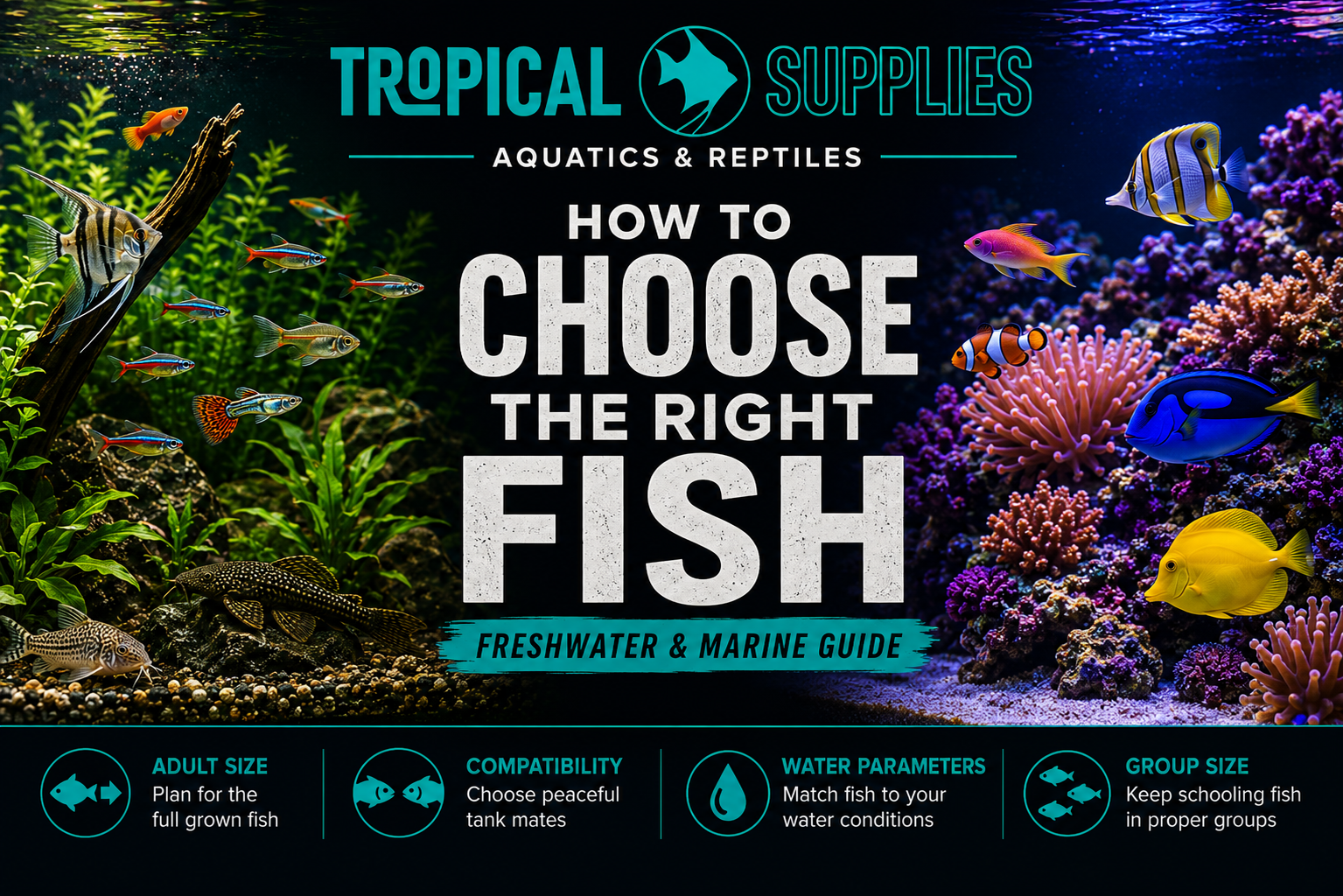
Choosing the Right Fish for Your Aquarium
Choosing livestock is one of the most exciting parts of setting up an aquarium.
It's also one of the areas where a little planning can prevent a lot of problems later.
A fish that looks tiny in the shop may grow considerably larger. Some species need to live in groups, while others become territorial. Some require particular water conditions, and two fish that look perfectly peaceful may simply be unsuitable tankmates.
The requirements are also very different between a tropical freshwater community and a marine aquarium, so we've separated this guide into two sections.
PART ONE — TROPICAL FRESHWATER FISH
PART TWO — MARINE FISH
Whichever type of aquarium you keep, remember one important rule:
Choose livestock for the aquarium you have — not the aquarium you hope they'll fit into.
PART ONE
CHOOSING TROPICAL FRESHWATER FISH
Freshwater aquariums offer an enormous choice of livestock, from tiny schooling tetras and colourful livebearers to Corydoras, plecos, loaches, gouramis, cichlids and unusual specialist species.
The key is building a community where the fish don't just survive together — they thrive together.
EXPLORE TROPICAL FRESHWATER LIVESTOCK →
1. Start With Your Aquarium Size
Before choosing the fish, consider the aquarium itself.
Both volume and physical dimensions matter.
A long aquarium can provide considerably more usable swimming space than a tall aquarium of a similar volume, which is particularly important for active species.
Rather than asking:
“How many fish can I fit in my aquarium?”
A much better question is:
“Which fish can comfortably live their entire lives in my aquarium?”
That immediately puts you on the right track.
2. Always Consider Adult Size
Most aquarium shops sell many species as juveniles.
That small fish you're looking at today may eventually become several times its current size.
This is particularly important with:
- Plecos
- Catfish
- Loaches
- Cichlids
- Gouramis
- Larger barbs
- Larger or more active specialist species
Some fish that are only a few centimetres long when purchased can eventually require extremely large aquariums.
Always buy for the adult fish, not just the juvenile you see today.
3. Check Your Water
One of the best ways to make freshwater fishkeeping easier is to understand the water you're starting with.
Different species naturally prefer different conditions.
Important parameters include:
- Temperature
- pH
- General hardness (GH)
- Carbonate hardness (KH)
- Ammonia
- Nitrite
- Nitrate
You don't need to become a water chemistry expert before keeping your first aquarium.
However, knowing whether your tap water is naturally soft or hard can help enormously when choosing livestock.
For many beginners, choosing fish that naturally suit their water is easier than constantly altering the water to suit their fish.
4. Compatibility Matters
Just because two fish are labelled as tropical doesn't mean they should live together.
Some freshwater species are peaceful.
Others are territorial.
Some become aggressive as they mature.
Others may be peaceful towards different species but aggressive towards their own kind.
Predatory behaviour also needs to be considered.
A simple rule worth remembering is:
If another fish is small enough to fit in its mouth, there's always a possibility it could eventually become food.
Research each species rather than assuming similar-sized fish will automatically get along.
5. Building a Community Aquarium
For beginners, a peaceful tropical community can be one of the most enjoyable aquariums to keep.
Rather than choosing lots of random species, think about building a balanced community.
For example:
Upper & mid-water:
Tetras, rasboras or suitable livebearers
Mid-water:
Gouramis or another suitable feature species
Bottom:
Corydoras, suitable loaches or smaller catfish
This creates movement throughout the aquarium rather than concentrating every fish in one area.
6. Some Fish Need to Live in Groups
This is one of the most important things to understand when stocking a freshwater aquarium.
Many popular species naturally live in groups and shouldn't be kept individually.
This includes many:
- Tetras
- Rasboras
- Barbs
- Corydoras
- Loaches
- Rainbowfish
The appropriate number varies depending on the species, so always research the particular fish you're considering.
Rather than keeping one or two individuals from lots of schooling species, it can be far better to choose fewer species and keep larger, appropriate groups.
This can encourage more natural behaviour, help fish feel secure and often looks much more impressive.
7. Think About Swimming Levels
Not every fish uses the aquarium in the same way.
Some spend most of their time around the surface.
Others occupy the middle of the aquarium.
Bottom-dwelling species spend much of their lives around the substrate.
When planning a community, consider:
TOP / UPPER WATER
Surface-orientated species
MID-WATER
Many tetras, rasboras, barbs and livebearers
BOTTOM
Corydoras, loaches and many catfish
You don't have to fill every level, but thinking about how your fish use the aquarium can create a much more balanced display.
8. Consider the Aquarium Layout
The livestock you choose should influence how you decorate the aquarium.
Some species appreciate dense planting.
Others require open swimming space.
Bottom-dwelling fish may need a suitable substrate.
Territorial species can benefit from caves, wood and rocks that create separate territories and break lines of sight.
Some species prefer strong water movement, while others naturally inhabit calmer environments.
Your aquarium shouldn't just look good to you — it needs to work for the animals living inside it.
9. Be Careful With Fin Nippers
Certain species have a reputation for nipping the fins of slower-moving or long-finned fish.
That doesn't necessarily make them a bad aquarium fish.
Sometimes inappropriate behaviour can be made worse by unsuitable tankmates, insufficient space or keeping a schooling species in too small a group.
But it does mean compatibility needs to be considered carefully.
Always research the particular species rather than assuming every small tropical fish is automatically suitable for a peaceful community.
10. Cichlids Need Extra Research
Cichlids are among the most fascinating freshwater fish available.
They're also an incredibly diverse group.
Some species can live successfully in community aquariums.
Others are territorial.
Some become extremely large.
Others are predators.
African Rift Lake cichlids can have very different requirements from many South American cichlids.
Simply knowing that a fish is a “cichlid” tells you very little about how it should actually be kept.
Research the individual species.
11. Plecos Aren't All the Same
The term “pleco” covers an enormous variety of fish.
Some species remain relatively compact, while others can grow extremely large.
They can also have different dietary, temperature and environmental requirements.
Don't simply buy a pleco because you want something to clean algae.
Plecos are animals with their own requirements and produce waste just like every other fish.
Many species can actually become spectacular feature fish in their own right.
12. Algae Eaters Don't Replace Maintenance
We hear this question regularly:
“What fish will clean my aquarium?”
There are fish, shrimp and snails that consume certain types of algae or organic material.
But there isn't an animal you can add that removes the need for proper aquarium maintenance.
Any animal you add will also eat and produce waste.
Choose algae-eating species because they're appropriate for your aquarium and because you actually want to keep them — not simply because you're looking for something to clean the tank.
13. Don't Forget Shrimp & Snails
A freshwater community doesn't have to contain only fish.
Shrimp and snails can add another dimension to the aquarium.
Freshwater shrimp in particular are available in an enormous range of colours and are fascinating animals to watch.
Compatibility still matters, though.
Small shrimp may become food for larger fish, and some species will actively hunt them.
Water parameters also need to be suitable.
EXPLORE FRESHWATER SHRIMP & INVERTEBRATES →
14. Build Your Stock Gradually
Even if you've planned your eventual community perfectly, don't necessarily add everything at once.
A recently established biological filter needs time to adjust as the amount of waste entering the aquarium increases.
Add a suitable initial group.
Monitor the fish.
Test the water.
Allow the aquarium to settle.
Then gradually introduce additional suitable livestock.
READ OUR AQUARIUM CYCLING GUIDE →
15. Have a Rough Stocking Plan
You don't need to decide every fish you'll ever own before adding the first one.
But having a rough plan is incredibly useful.
A simple community might eventually contain:
Schooling fish:
One good-sized group of tetras or rasboras
Feature fish:
A suitable gourami or another compatible centrepiece species
Bottom dwellers:
A suitable group of Corydoras
Invertebrates:
Compatible shrimp or snails
This is often much more successful than buying random fish and trying to work out compatibility afterwards.
16. Don't Rely Entirely on “Fish Per Litre” Rules
Simple stocking formulas can be misleading.
Ten tiny tetras and one large cichlid may technically add up to a similar total length, but their requirements are completely different.
Stocking depends on:
- Adult size
- Body mass
- Activity
- Territorial behaviour
- Waste production
- Filtration
- Aquarium dimensions
- Swimming space
- Group requirements
- Compatibility
There isn't one mathematical formula that works perfectly for every aquarium.
EXPLORE TROPICAL FRESHWATER LIVESTOCK →
PART TWO
CHOOSING MARINE FISH
Choosing marine livestock requires a slightly different approach.
Marine aquariums can contain fish with extremely different diets, behaviours and territorial requirements, while reef aquariums introduce another consideration entirely — compatibility with corals and invertebrates.
Planning ahead is extremely important.
1. Plan the Final Aquarium Before Buying the First Fish
With marine aquariums, it's particularly useful to have an idea of what you eventually want to keep.
Are you building a:
- Fish-only aquarium?
- Fish-only system with live rock?
- Mixed reef?
- Soft coral reef?
- LPS/SPS reef?
- Predator aquarium?
You don't need to decide every single animal immediately.
But knowing the general direction of the aquarium can prevent you from buying a fish now that limits your choices later.
2. Consider Adult Size
Just like freshwater fish, many marine fish are sold as juveniles.
That little tang, angelfish or triggerfish can become a substantial animal.
Some marine species are also extremely active swimmers.
This means the length and dimensions of the aquarium can be just as important as its total volume.
Always plan for the adult fish.
Don't assume you'll simply upgrade the aquarium later.
3. Understand Territorial Behaviour
Territorial behaviour is particularly important when planning a marine community.
Many marine fish establish an area of the aquarium as their territory.
Some can become aggressive towards new arrivals.
Others may be particularly aggressive towards fish with similar shapes or colours.
This means two species that could theoretically live together may still cause problems if introduced incorrectly.
Research the individual species and think about the eventual community, not simply the next fish you're buying.
4. Stocking Order Can Matter
This is where marine stocking can be very different from building a straightforward freshwater community.
The order in which fish are introduced can sometimes make a significant difference.
If a highly territorial fish is allowed to establish the entire aquarium as its territory first, adding more peaceful species afterwards may be difficult.
Where appropriate, introducing more peaceful species first and more assertive species later can help.
There isn't one stocking order that works for every aquarium.
This is another reason why planning your eventual livestock before you start buying is so valuable.
5. Reef Safe Doesn't Always Mean the Same Thing
If you're planning a reef aquarium, compatibility goes beyond whether two fish will fight.
You also need to consider:
- Corals
- Shrimp
- Crabs
- Snails
- Starfish
- Other invertebrates
A fish may leave your corals completely alone but happily eat ornamental shrimp.
Another species might coexist with invertebrates but nip certain corals.
Some fish may behave perfectly in one reef aquarium and differently in another.
Treat “reef safe” as something to research for the individual species rather than assuming it's always a simple yes or no.
EXPLORE MARINE INVERTEBRATES →
6. Consider Diet Before Buying
Marine fish can have very different feeding requirements.
Some species readily accept a wide variety of frozen, dry and prepared foods.
Others have much more specialised diets.
Before buying a fish, find out:
What does it naturally eat?
Will it accept prepared aquarium foods?
How frequently should it be fed?
Can you realistically provide that diet long-term?
A beautiful fish isn't necessarily the right fish for your aquarium.
7. Think About Swimming Space
Different marine species use their environment very differently.
Tangs can be extremely active swimmers.
Gobies may spend much of their time around the substrate and rockwork.
Clownfish may occupy a relatively small area.
Wrasses can be highly active.
Some species spend much of their time moving between caves and rockwork.
Your aquascape should provide both suitable shelter and appropriate swimming space for the animals you intend to keep.
8. Does the Fish Need Sand?
This is something that's easily overlooked when planning a marine aquarium.
Certain marine species naturally bury themselves in the substrate, including some wrasses.
For these animals, the substrate isn't simply decoration.
It's part of their environment.
If you're planning a bare-bottom aquarium or using an unsuitable substrate, certain species may therefore be inappropriate.
Think about livestock before finalising the aquarium layout.
9. Does Your Aquarium Need a Lid?
Some marine fish are extremely capable jumpers.
Wrasses, gobies and various other species can leave an uncovered aquarium surprisingly easily.
Before purchasing a species, check whether jumping is a known behaviour and make sure the aquarium has suitable protection where necessary.
It's much easier to install a suitable cover before bringing the fish home.
10. Don't Buy Livestock Simply to Solve a Problem
The marine equivalent of buying a freshwater “cleaner fish” is purchasing livestock solely because you've heard it eats algae or a particular pest.
There are certainly marine animals that can help control particular algae and pests.
But that's only useful if the animal is otherwise suitable for the aquarium.
Ask:
How large will it grow?
What happens when the original food source disappears?
Is it compatible with my other livestock?
Is it reef safe for what I keep?
Can I provide its long-term diet?
Choose livestock because you can meet its requirements — not simply because you want it to perform a job.
11. Introduce Marine Fish Gradually
Don't fully stock a new marine aquarium in one go.
The biological filtration needs to adapt as livestock and feeding increase.
Introduce appropriate livestock gradually.
Monitor behaviour.
Test your water.
Allow the aquarium to stabilise.
Then consider the next addition.
Marine aquariums often reward patience.
At the same time, as we explain in our cycling guide, you don't necessarily need to leave a properly prepared marine aquarium sitting empty indefinitely. Once the system is ready, appropriate initial livestock can begin establishing the aquarium — just take things steadily from there.
READ OUR AQUARIUM CYCLING GUIDE →
12. Think Beyond the Fish
One of the biggest differences with marine aquariums is that the fish may eventually be only one part of the livestock.
You might later want:
- Corals
- Anemones
- Shrimp
- Crabs
- Snails
- Starfish
- Other marine invertebrates
A fish you choose today could determine which of those animals you can safely add in the future.
If your eventual goal is a reef aquarium, make livestock decisions with that future reef in mind from the beginning.
EXPLORE MARINE INVERTEBRATES →
13. Ask Before Buying Something You're Unsure About
Marine livestock can be incredibly varied, and there is no reason to guess.
If you're unsure about a particular species, tell us:
- Your aquarium size
- How long it has been running
- Your current livestock
- Whether you keep corals
- Which invertebrates you have
- What you eventually want the aquarium to become
That information makes it much easier for us to help you choose something appropriate.
EXPLORE MARINE LIVESTOCK →
ADVICE FOR BOTH FRESHWATER & MARINE KEEPERS
Whichever type of aquarium you're building, there are a few principles worth remembering.
Research Before You Buy
Before buying any livestock, try to answer:
How large will it grow?
What does it eat?
What temperature does it require?
What water conditions does it need?
Does it need to live in a group?
Is it territorial?
What can it live with?
Does it require a particular substrate or environment?
Is my aquarium actually suitable long-term?
A few minutes of research before buying can prevent a lot of problems afterwards.
Fewer Species Can Sometimes Look Better
A great aquarium isn't necessarily the aquarium containing the most different fish.
In freshwater, a large group of one schooling species can look far more impressive than one or two individuals from lots of different species.
In marine aquariums, carefully selected fish with enough space to establish natural territories can produce a much calmer and more impressive display.
Think about the aquarium as a complete ecosystem rather than a collection of individual animals.
Don't Rush
You don't need to fill every available space immediately.
Aquariums change as they mature.
Your interests may change too.
You might discover a particular species six months from now that you'd love to own.
Leaving yourself some room gives you options.
Take your time and enjoy building the aquarium.
Ready to Choose Your Fish?
Once your aquarium is set up and ready for livestock, choosing the fish is where everything really starts coming to life.
Whether you're building a peaceful tropical freshwater community or planning a marine reef, take the time to consider adult size, compatibility, behaviour, diet, water requirements and the eventual direction of the aquarium.
At Tropical Supplies, we stock a huge and constantly changing selection of freshwater and marine livestock, from popular community species through to unusual and specialist fish and invertebrates.
And if you're unsure about anything, visit us in store and speak to a member of the Tropical Supplies team.