
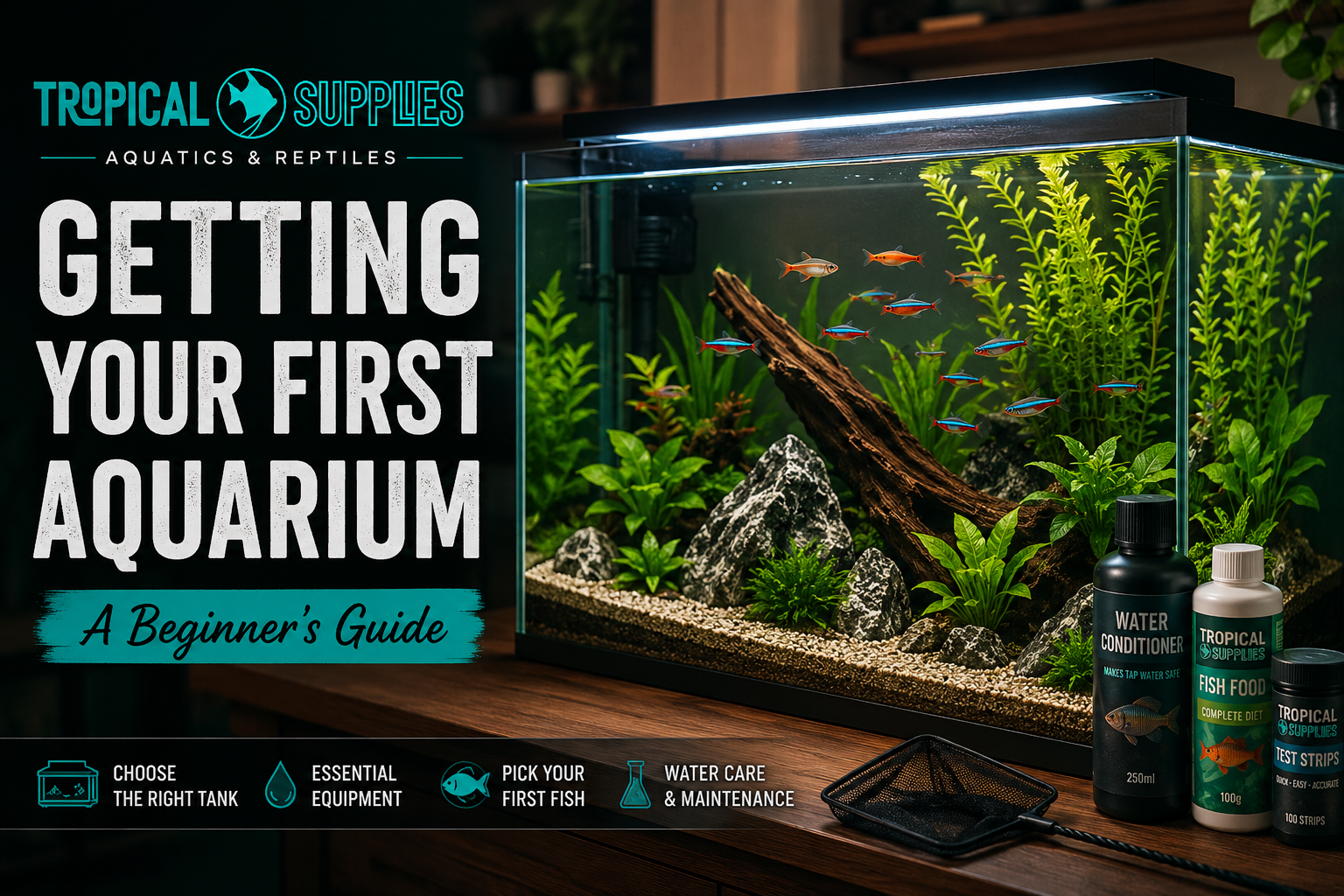
Getting Your First Aquarium
Setting up your first aquarium is an exciting experience, but with so many different tanks, filters, foods, water treatments and fish to choose from, it can be difficult to know where to start.
The good news is that fishkeeping doesn't need to be complicated.
Getting the basics right from the beginning will give you a much better chance of creating a healthy, stable aquarium that both you and your fish can enjoy for years to come.
In this guide, we'll take you through the process step by step — from choosing your first aquarium to getting it ready for its first inhabitants.
Choosing Your First Aquarium
One of the first decisions you'll need to make is the size of your aquarium.
It can be tempting to start with the smallest tank possible, particularly if you're new to fishkeeping. However, a slightly larger aquarium can actually be easier for a beginner to maintain.
Larger volumes of water tend to be more stable. Changes in temperature and water chemistry generally happen more slowly, giving you a little more room for error while you're learning.
The size you choose will ultimately depend on the space available, your budget and, most importantly, the species you'd eventually like to keep.
Before buying an aquarium, think about where it will be positioned. Once filled with water, substrate and decoration, aquariums become extremely heavy and aren't something you'll want to move.
Choose a strong, level surface or a cabinet specifically designed to support the aquarium.
SHOP AQUARIUMS & CABINET SETS →
Decide What You'd Like to Keep
It's worth thinking about your eventual livestock before buying the aquarium.
Different fish have very different requirements when it comes to aquarium size, temperature, water chemistry, swimming space and compatibility.
A small community of peaceful tropical fish, for example, requires a very different setup from large cichlids or coldwater fish.
You don't need to know your complete stocking list yet, but having a general idea will help you choose suitable equipment from the beginning.
When you're eventually ready to add livestock, you can explore our Freshwater Fish range to see the huge variety of species available.
EXPLORE FRESHWATER LIVESTOCK →
What Equipment Does a First Aquarium Need?
The exact equipment required will depend on what you're planning to keep, but most freshwater aquariums will need several essentials.
Aquarium
Choose an aquarium suitable for the adult size and requirements of the fish you'd eventually like to keep.
Remember that the advertised volume is the aquarium's approximate maximum capacity. Once substrate, rocks, wood and equipment are added, the actual amount of water inside will be lower.
Filter
Your filter is one of the most important pieces of equipment in the aquarium.
It removes debris from the water, but more importantly it provides somewhere for populations of beneficial bacteria to establish.
These bacteria form an essential part of the aquarium's biological filtration and help process harmful waste produced by fish and other organic material.
Filters come in many forms, including internal filters, hang-on filters and external canister filters.
Heater
Most tropical freshwater fish require a stable temperature above normal UK room temperature, meaning you'll usually need an aquarium heater.
The correct temperature depends on the species you're keeping, so always research your intended livestock rather than assuming every tropical fish requires exactly the same temperature.
Lighting
Aquarium lighting allows you to enjoy your aquarium and is particularly important if you're planning to keep live plants.
Many modern aquariums include LED lighting as standard.
Avoid leaving aquarium lights switched on continuously. Fish benefit from a regular day/night cycle, and excessive lighting can contribute to unwanted algae growth.
Choosing Substrate
Substrate is the material covering the bottom of your aquarium, usually gravel or sand.
The best choice depends partly on the fish you're planning to keep.
Some species spend much of their time around the bottom of the aquarium and may appreciate a softer substrate, while planted aquariums may benefit from substrates designed specifically to support plant growth.
This is another reason why thinking about your eventual livestock before setting up the aquarium is worthwhile.
Decorating Your Aquarium
This is where you can really start making the aquarium your own.
Rocks, wood, caves, ornaments and live plants can transform an empty glass aquarium into an attractive underwater environment.
Decoration isn't purely cosmetic either.
Fish use plants, wood, rocks and caves for shelter, territory and security. Providing suitable hiding places can help fish display more natural behaviour and feel more comfortable in their environment.
Just make sure anything placed inside the aquarium is safe for aquarium use.
Consider Live Plants 🌿
Live aquarium plants can be a fantastic addition to a freshwater aquarium.
As well as looking natural, plants provide shelter and structure for fish and can contribute towards a more natural aquarium environment.
Some plants are extremely forgiving and make excellent choices for beginners.
Different plants have different lighting and nutritional requirements, so you don't necessarily need to begin with a heavily planted aquarium.
At Tropical Supplies we stock a wide selection of live aquarium plants, so you can start simple and add more as your confidence grows.
Filling Your Aquarium
Once your substrate, decoration and equipment are in place, you're ready to add water.
If you're using normal tap water, it should be treated with a suitable water conditioner.
UK tap water is treated to make it safe for us to drink, but chlorine or chloramine can be harmful to aquatic life and to the beneficial bacteria we're trying to establish in the aquarium.
Always follow the dosage instructions on the water conditioner you're using.
Once filled, switch on the filter and heater and check that everything is operating correctly.
The Most Important Part: Cycling Your Aquarium
This is one of the most important things for every new fishkeeper to understand.
A newly filled aquarium isn't immediately a mature aquarium.
Fish produce waste. Uneaten food and other organic material also break down within the aquarium.
This can result in ammonia, which is toxic to fish.
Beneficial bacteria eventually establish within the aquarium — particularly within the biological media inside your filter — and process this waste.
In simple terms, ammonia is converted into nitrite, which is also toxic, before other bacteria convert nitrite into nitrate.
This process is commonly known as the nitrogen cycle.
Establishing biological filtration before heavily stocking an aquarium is incredibly important. Adding too many fish to an immature aquarium can result in dangerous ammonia or nitrite levels.
Patience at this stage can prevent a lot of problems later.
We'll cover the entire process in much more detail in our dedicated Beginner's Guide to Cycling an Aquarium.
You Need a Water Test Kit
Water can look perfectly clear while still containing harmful levels of ammonia or nitrite.
That's why testing aquarium water is so important.
For a new freshwater aquarium, you should be able to monitor important parameters including:
Ammonia • Nitrite • Nitrate • pH
Testing allows you to understand what's actually happening inside the aquarium rather than relying on appearance alone.
It's particularly important while an aquarium is becoming established and whenever you're experiencing unexplained problems with your fish.
When Can I Add My First Fish?
Don't rush this stage.
Before adding livestock, you want the aquarium running correctly and its biological filtration becoming established.
How you cycle the aquarium can affect how long this takes, which is why we'll cover cycling separately rather than giving a blanket number of days.
Once the aquarium is ready, start sensibly rather than filling it with its complete population immediately.
Introducing livestock gradually gives the biological filtration time to adapt to the increased amount of waste being produced.
Choosing Your First Fish 🐠
This is the part most new fishkeepers have been waiting for!
But don't simply choose fish based on appearance.
Before buying any species, consider:
Adult size — that tiny fish in the shop may not stay tiny.
Aquarium size — does your aquarium provide enough space when the fish is fully grown?
Temperature — is it compatible with the rest of the aquarium?
Water requirements — some species have particular preferences.
Temperament — peaceful community fish and aggressive or territorial species aren't necessarily compatible.
Group size — many fish are naturally social and should be kept in appropriate groups.
Diet — make sure you're able to provide the correct food.
At Tropical Supplies, we stock a huge variety of freshwater livestock, from familiar community favourites to unusual and specialist species.
If you're unsure what would work in your aquarium, ask us before buying. Helping you choose compatible livestock is much easier than trying to solve compatibility problems afterwards.
Don't Add Too Many Fish at Once
Even once an aquarium is ready for livestock, avoid adding a large number of fish immediately.
Every new animal increases the amount of waste the biological filter needs to process.
Building your stocking level gradually allows the aquarium's bacterial population to adjust.
It also gives you time to observe your new fish and make sure everything is healthy before introducing more.
Feeding Your New Fish
Overfeeding is one of the easiest mistakes to make when you're new to fishkeeping.
Fish don't need enormous amounts of food, and food left uneaten eventually breaks down and contributes to poor water quality.
Choose a good-quality food appropriate for the species you're keeping and feed sensible portions.
Variety can also be beneficial depending on the species, with options including flakes, pellets, wafers, frozen foods and live foods.
Aquarium Maintenance
An aquarium isn't something you set up once and then leave indefinitely.
Regular maintenance is an important part of keeping fish healthy.
A typical routine may include:
- Partial water changes
- Testing water parameters
- Removing debris
- Cleaning the aquarium glass
- Maintaining the filter
- Trimming and maintaining live plants
- Checking equipment
- Observing your livestock
How frequently each task is required depends on the aquarium, its size, filtration and stocking level.
Don't Over-Clean Your Filter
One particularly important beginner tip is to be careful when cleaning filter media.
A large population of the beneficial bacteria your aquarium relies upon lives inside the filter.
You generally don't want to make everything completely sterile.
Filter media should be maintained according to the manufacturer's instructions, and biological media shouldn't simply be replaced unnecessarily because it looks dirty.
We'll cover filter maintenance in its own guide.
Common First Aquarium Mistakes
Most fishkeepers make mistakes when they're starting out. Understanding some of the most common ones can help you avoid them.
Buying the aquarium before researching the fish
Adding livestock too quickly
Adding too many fish at once
Not understanding the nitrogen cycle
Not testing the water
Overfeeding
Choosing incompatible species
Buying fish without considering their adult size
Cleaning or replacing too much filter media at once
Making large changes whenever something looks wrong rather than testing the water first
Getting these fundamentals right will make your first aquarium considerably easier to manage.
Your First Aquarium Doesn't Need to Be Complicated
There's an enormous amount to learn in fishkeeping, but you don't need to know everything on day one.
Start with the fundamentals:
Choose an appropriate aquarium.
Research what you'd like to keep.
Install suitable filtration and heating.
Treat your tap water.
Understand the nitrogen cycle.
Test your water.
Introduce suitable livestock gradually.
Maintain the aquarium regularly.
Get those basics right and you'll have a strong foundation to build upon as your experience grows.
Ready to Start Your First Aquarium?
At Tropical Supplies, we can help with everything from choosing your first aquarium to selecting suitable livestock once it's ready.
And if you're unsure about anything, visit us in store and speak to a member of the Tropical Supplies team. We'd much rather help you get things right from the beginning.